Worlds Upon Worlds Press
In summer 2026, I launched my own publishing imprint, Worlds Upon Worlds Press. I plan on specializing in speculative poetry, science fiction, and fantasy books. The press will sometimes utilize AI in the creation of publications, which will always be fully disclosed. I launched this press because too many publishers and authors are resistant to AI, ceding the discussion about the role of AI in creative writing to the tech companies. I want a space where authors can freely experiment with these tools to create the best literature they can!
Seven Seasons: The X9 Saijiki
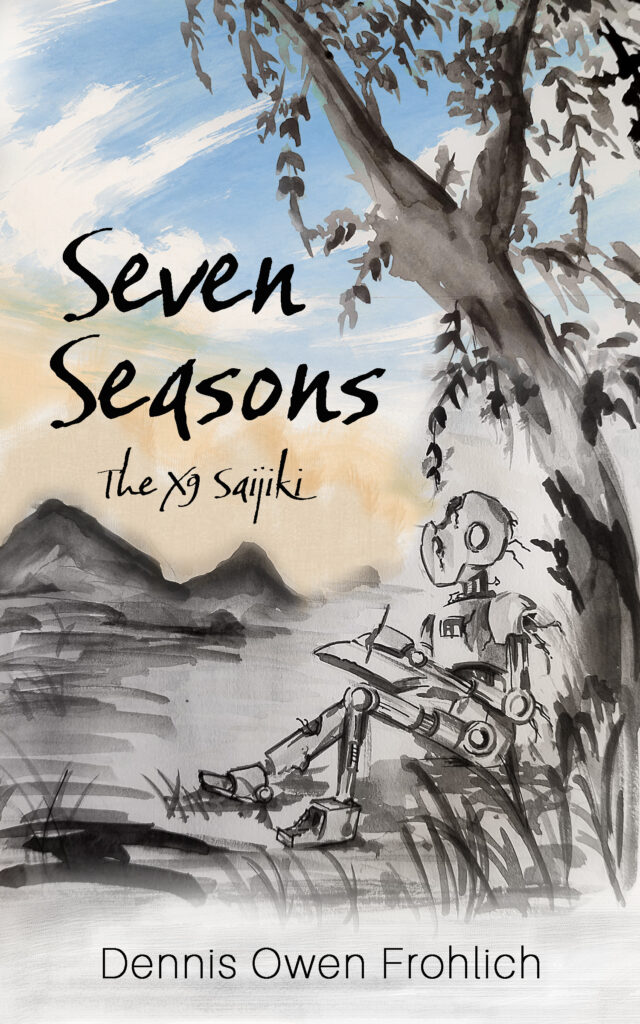
On Wednesday, Sept. 9, 2026, I released my speculative poetry debut, Seven Seasons: The X9 Saijiki!
In a future Japan reshaped by ecological collapse and runaway technology, the four traditional seasons have vanished. In their place rise new and haunting seasons: Oil Tides, Chemical Clouds, Nuclear Bloom, and other strange cycles of life and decay. Amid the ruins and reinventions of nature, six intelligent species—humans, cyborgs, mutants, robots, AI consciousnesses, and monkeys—turn to haiku to make sense of their fractured world.
This is their saijiki: a compendium of seasonal words and poems written during the year X9. Across seven seasons, more than 270 haiku explore dozens of invented seasonal phenomena, each viewed through the perspectives of the six species that inhabit this transformed Earth. The collection is framed by commentary from Waylan West, a far-future professor of Pre-Interstellar Cyberculture.
From a time when Earth is no longer habitable and humanity has scattered into the stars, West looks back on the year X9 not with horror, but with nostalgia. To us in the present day, X9 might feel apocalyptic. To him, it was still beautiful.
The book is available through Amazon in both print ($24.99) and ebook ($9.99) versions! You can also purchase the book on Barnes and Noble, Bookshop.org, Walmart, and international versions of Amazon, including the UK, France, Germany, Japan, Australia, and more!
Follow me on Instagram for updates on the book, including book signings and events!
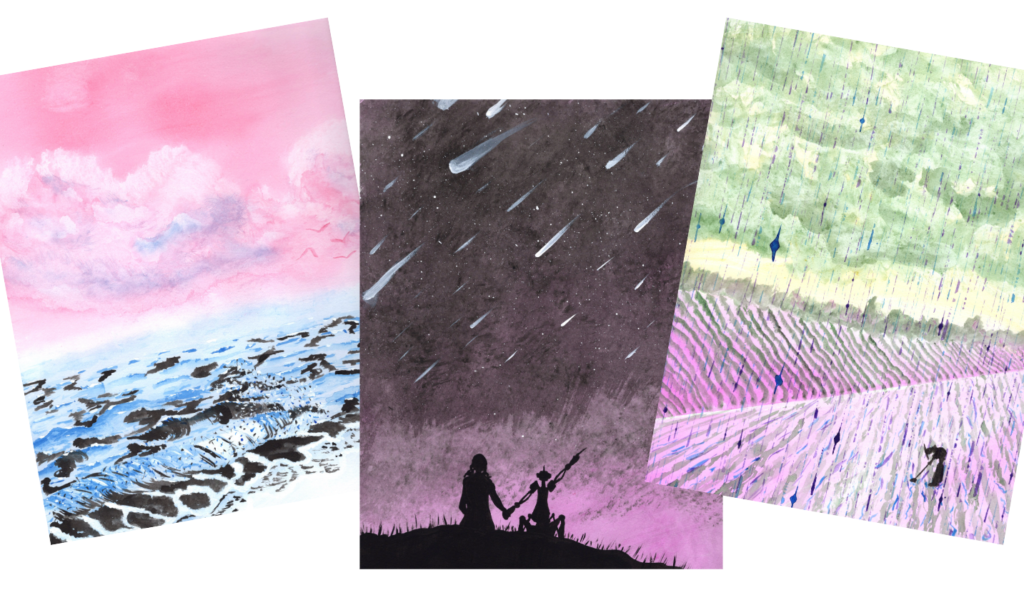
The book features 7 ink paintings, one for each season!
Early reviews are in!
Seven Seasons: The X9 Saijiki is a work of literary genius that takes experimental haiku and poetry to an entirely new frontier. Bold, visionary, and unapologetically original, it transcends the boundaries of traditional haiku literature, creating a space where science fiction, imagination, and poetic innovation converge.
~Hifsa Ashraf – Poet, Author, and Editor
Co-Author of Infinity StringsThis story functions as a brave new example of limited AI-generated worldbuilding in creative writing, and is an amazing, intriguing and intelligent use of modern tools. Its shear wonder lies in its careful application of those methods interspersed with some of the most beautiful, evocative scifaiku I have ever read.
~t.santitoro, editor, Scifaikuest
Author of The Dark Side of GreenSeven Seasons is a fantastic journey into the imagined future of haiku. It is a work of unique creativity and vision: original, expansive and detailed in its worldbuilding. There is nothing else out there that combines elements of traditional Japanese culture, poetry, and science fiction. Dennis has created something entirely new here, a work of speculative poetic fiction that may be the first in a new genre to be copied and appreciated for generations to come.
~Jay Friedenberg – President of the Haiku Society of America, 2020-2022.
Author of Sci-Ku: Explorations into the Poetry of Science
The book also features an essay, “On the Use of AI in Seven Seasons” which details how AI was used for research, worldbuilding, name generation, and publication advice. AI was employed after the book was already written, and all content remains my unique, creative vision. I’m hoping to inject nuance into the debate around AI tools and creative writing, a debate that too often views AI use as either 100% or nothing. Too often the debate in publishing starts and ends at “AI use is bad,” which isn’t helpful for creatives nor readers. I want to be an active participant in this debate, not letting tech companies control the narrative about AI’s uses and applications.